
THE WORD MAPPING PACK
For the word they read today and can't remember tomorrow.
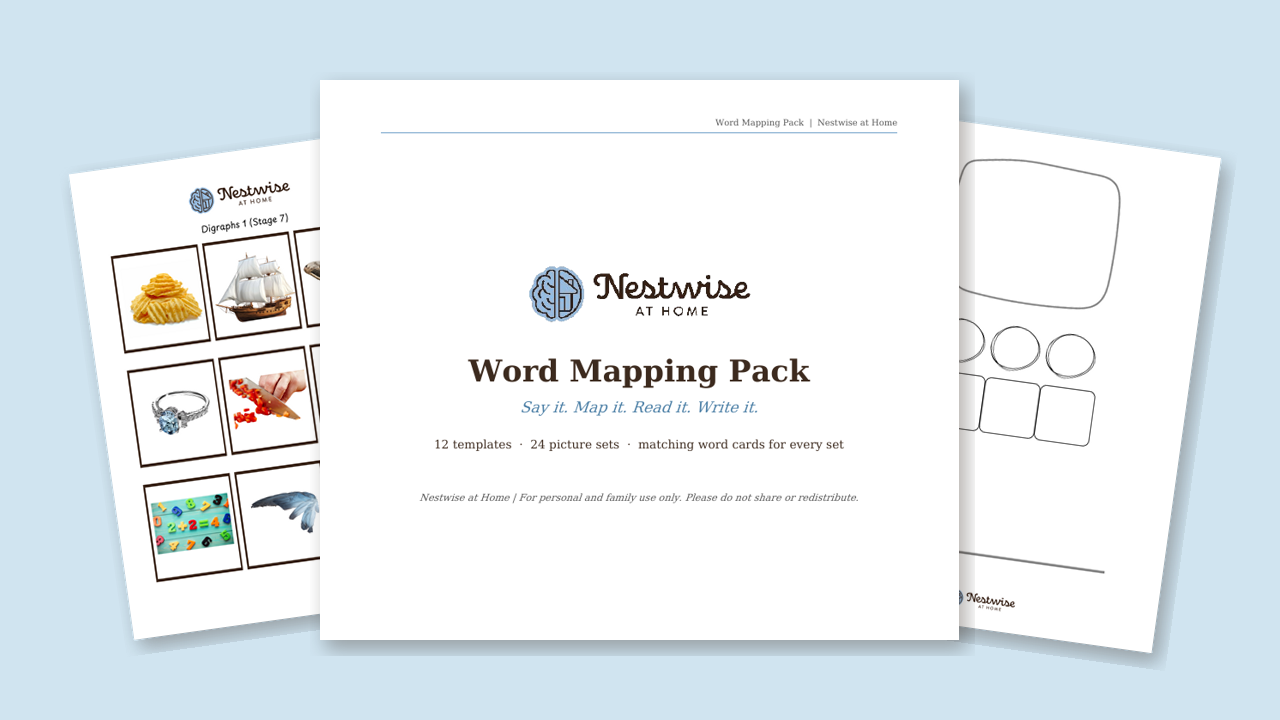
Word mapping templates, 24 sets of picture cards in my Letter and Sound Sequence order, and matching word cards for every set. The same few steps, every time.
 Get the pack
$19 AUD · One-time payment · Instant download
They read it yesterday. Today it's brand new.
Your child sounds out a word, gets it, and you feel that little rush. Then the next day it's like they've never seen it before.
That's such a normal part of learning to read (and it can feel SO frustrating). It doesn't mean they're not trying, or that you're doing it wrong. It means the word hasn't been stored yet.
Word mapping is how it gets stored.
A simple routine you can use with every word
The Word Mapping Pack is a 65 page printable pack. It has 12 reusable templates and 24 sets of photo picture cards, from CVC words all the way to bossy r, tch and dge, and vowel teams. Every set has matching word cards, so your child can check their mapping, or play matching games.
Say it
Pop a picture card in the template and say the word together.
Map it
One object for each sound, then the letters for each sound.
Read it and write it
Read it back, write it, and check it with the word card.
Everything you need to map words at home
- 12 templates with 3, 4 and 5 sounds, portrait or landscape, plain or with picture prompts for each step
- 24 picture card sets in my Letter and Sound Sequence order: CVC words, digraphs, blends, ll ff ss zz, ck, magic e, bossy r, tch and dge, and vowel teams
- Matching word cards for every set, with the set printed on every card (so when they end up under the couch, you can sort them back again)
- A mapped word list: every picture named and mapped sound by sound (g | oa | t), so you can check any word in seconds
- A how to use page and a clickable contents page
- A video walkthrough showing how to map a word, and how to adapt it for demand sensitive kids
Words stick when sounds connect to letters
When a child reads a word instantly, it's because their brain has connected each sound in that word to the letters that spell it, and stored it. Word mapping builds that connection on purpose. Sounds first, then letters, then the whole word.
It also shows your child how words actually work. That sh is one sound with two letters. That tch is one sound with three. So they're not trying to remember what a word looks like, they're learning why it's spelled that way.
And because every set follows my sequence, the words are made from sounds your child has already been taught. Lots of practice, lots of success.
In the video I share ways to soften word mapping for demand sensitive kids. Small changes that take the pressure off, so it can feel safe and doable and your child still gets all of the practice.
One word, mapped together, still counts. It's practice that actually happens, which is the whole point.
Is this right for your family?
- Your child is learning to read with phonics and words aren't sticking yet
- You want a simple, repeatable routine that works for every pattern
- You'd like reading and spelling practice in one
- You want something hands-on that isn't a worksheet
The Word Mapping Pack
- 12 word mapping templates
- 24 picture card sets, in sequence order
- Matching word cards for every set
- A mapped word list
- A video walkthrough
Say it. Map it. Read it. Write it.
A few minutes of word mapping is one of the most useful things you can do for a beginning reader.
P.S. Word mapping is the practice. If you'd like the teaching that comes before it, every sound and pattern in order and how to make it work in a home that looks nothing like a classroom, that's Teach Your Child to Read.